

As a supplier of transparent bags in boxes, accurately measuring the volume of these bags is crucial for both production and customer satisfaction. In this blog post, I'll share several reliable methods to measure the volume of a transparent bag in a box.
Why Measuring Volume Matters
Before diving into the measurement methods, it's essential to understand why measuring the volume of a transparent bag in a box is so important. For us as suppliers, precise volume measurement ensures that we can provide accurate product specifications to our customers. Whether it's for packaging liquid beverages, olive oil, or other products, knowing the exact volume helps our customers plan their filling processes, storage, and transportation. It also allows us to maintain consistent quality control during production, ensuring that each bag meets the required volume standards.
Method 1: Water Displacement Method
The water displacement method is a classic and straightforward way to measure the volume of an irregularly - shaped object, such as a transparent bag in a box. Here's how you can do it:
- Prepare a large container: Select a container large enough to fully submerge the transparent bag in the box. It should have volume markings on the side, like a graduated cylinder or a large measuring tank.
- Fill the container with water: Pour enough water into the container so that the bag can be completely covered. Record the initial volume of water, (V_1).
- Submerge the bag: Carefully place the transparent bag in the box into the water, making sure no air bubbles are trapped inside the bag. If there are air bubbles, gently tap the bag to release them.
- Record the final volume: Once the bag is fully submerged, note the new volume of water in the container, (V_2).
- Calculate the volume: The volume of the transparent bag in the box is equal to the difference between the final and initial volumes, i.e., (V = V_2 - V_1).
This method is highly accurate as long as the water displacement is measured precisely. However, it may not be suitable for bags that are not waterproof or for bags that contain products that are sensitive to water.
Method 2: Mathematical Calculation
If the transparent bag in the box has a regular shape, such as a rectangular prism or a cylinder, you can use mathematical formulas to calculate its volume.
Rectangular Prism
If the bag is in the shape of a rectangular prism, you need to measure its length ((l)), width ((w)), and height ((h)). The volume formula for a rectangular prism is (V=l\times w\times h).

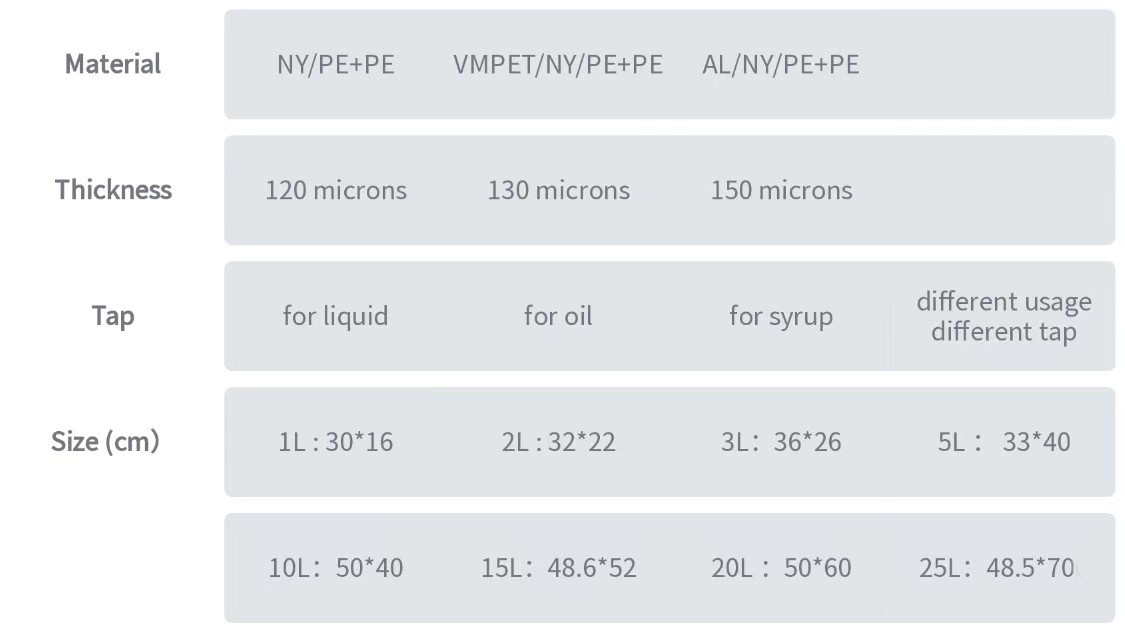
- Measure the dimensions: Use a measuring tape or a ruler to measure the length, width, and height of the bag. Make sure to measure from the inside of the bag for the most accurate result.
- Calculate the volume: Multiply the three dimensions together to get the volume of the bag.
Cylinder
For a cylindrical bag, you need to measure the radius ((r)) of the base and the height ((h)) of the bag. The volume formula for a cylinder is (V = \pi r^{2}h).
- Measure the dimensions: Measure the diameter of the base of the cylinder and divide it by 2 to get the radius. Then measure the height of the bag.
- Calculate the volume: Substitute the values of (r) and (h) into the formula and calculate the volume.
This method is relatively quick and easy, but it requires the bag to have a regular shape. If the bag has an irregular shape, this method may not provide accurate results.
Method 3: Using a Volumetric Filling Machine
In a production environment, using a volumetric filling machine can be an efficient way to measure the volume of the transparent bag in the box.
- Calibrate the machine: First, calibrate the volumetric filling machine according to the desired volume of the bag. This usually involves adjusting the settings of the machine to dispense a specific amount of liquid.
- Fill the bag: Use the calibrated machine to fill the transparent bag in the box with a liquid. The machine will dispense the liquid in a pre - determined volume.
- Verify the volume: After filling, you can double - check the volume by weighing the filled bag (if the density of the liquid is known) or by using other measurement methods.
This method is suitable for mass production as it can ensure consistent volume measurement for each bag. However, it requires an investment in a volumetric filling machine and proper calibration.
Application in Different Products
Our transparent bags in boxes are used for a variety of products, such as liquid beverages, olive oil, and juice. Each product may have different requirements for volume measurement.
For Liquid Beverage Bag in Box, accurate volume measurement is essential for meeting regulatory requirements and customer expectations. Beverage manufacturers need to know the exact volume of each bag to ensure proper pricing and product consistency.
Transparent Bib Bag in Box For Olive Oil Food Grade Plastic Container For Juice Milk Beverage is often used for high - value products like olive oil. Measuring the volume accurately helps prevent over - filling or under - filling, which can affect the quality and cost of the product.
The Transparent Bag in Box with Tap is a popular choice for products that require easy dispensing. Measuring the volume correctly ensures that the tap is designed to dispense the appropriate amount of product.
Conclusion
Accurately measuring the volume of a transparent bag in a box is essential for our business as a supplier. We can use methods such as water displacement, mathematical calculation, or volumetric filling machines to achieve accurate volume measurement. Each method has its own advantages and disadvantages, and the choice of method depends on the shape of the bag, the type of product it contains, and the production environment.
If you are interested in our transparent bags in boxes or have any questions about volume measurement, we welcome you to contact us for procurement and further discussions. We are committed to providing high - quality products and professional services to meet your needs.
References
- Fundamentals of Fluid Mechanics by Bruce R. Munson, Donald F. Young, and Theodore H. Okiishi
- Introduction to Engineering Measurement by Robert A. Dally, Wallace F. Riley, and Kenneth G. McConnell


